
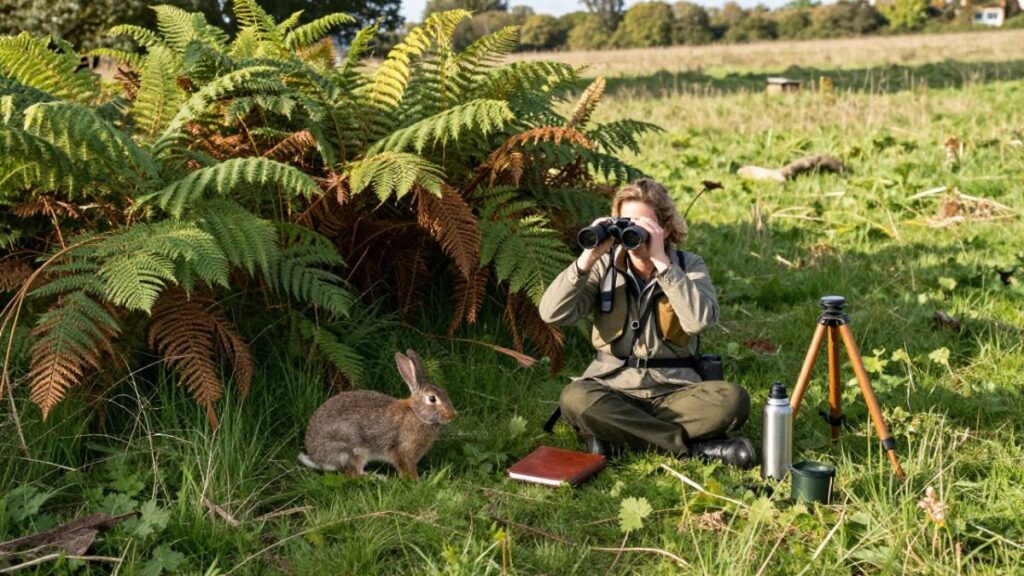
Quick Summary
Primary consumer adaptations to predators include camouflage, speed and agility, sensory vigilance, group living, and last-resort tactics like thanatosis. Each defense is matched to the habitat and predator community an animal faces, and each carries an energy cost that trades off against feeding and reproduction.
- Camouflage works before a chase starts, but only when it matches the surroundings.
- Speed and agility depend on rapid acceleration, sustained running, and sudden directional changes.
- Herd and schooling behavior spreads vigilance, so more eyes scanning means earlier threat detection.
- Thanatosis, or playing dead, is a last-resort tactic that works only against some predators.
- Every defense carries a cost, such as energy use or lost feeding time from constant scanning.
Table of Contents
- What Primary Consumers Are and Why They Face Predators
- Camouflage and Concealment as the First Line of Defense
- Speed, Agility and Escape Behavior
- Predator and Prey Examples Across Habitats
- Thanatosis: Playing Dead as a Prey Adaptation
- Trade-Offs, Energy Costs and Evidence for Evolutionary Change
- Applying These Adaptations: A Primary Consumer Adaptations to Predators Worksheet
- Frequently Asked Questions
What Primary Consumers Are and Why They Face Predators
Last Updated: November 13, 2026
Primary consumers are animals that eat producers, meaning plants and algae, and sit one step above them in the food chain. Deer, zebras, rabbits, and many insects all fall into this group. Because they are a food source for carnivores, primary consumers face constant predation pressure, which has driven the evolution of an impressive range of defensive traits. This guide from Accurate Market Research breaks down seven ways these animals avoid being eaten, drawing on the functional trait research available to us.
A predator is an organism that hunts and kills another animal for food, while the animal it hunts is the prey. Primary consumers are prey for many predators, which is why their defenses matter so much to ecosystem structure. A useful way to see the relationship is through trophic level: energy moves from producers to primary consumers, then to secondary consumers, and so on. The primary consumer layer absorbs much of the predation pressure in that chain.
Researchers who study predator and prey functional traits argue that these traits help explain adaptive interactions between the two groups. In other words, the shape of a prey animal’s body, its senses, and its behavior are not random. They reflect a long history of interaction with the animals trying to eat it. The functional trait literature is often grouped into broad categories of defense: visual concealment, physical speed and agility, sensory vigilance, and behavioral tactics.
Watch out: a trait that protects a primary consumer in one habitat can become a liability in another, so defenses should always be judged against the specific predators present.
Camouflage and Concealment as the First Line of Defense
Camouflage is often the cheapest defense a primary consumer can have, because it works before a predator ever starts a chase. Many prey species blend into their surroundings through coloration, patterning, or body shape that breaks up their outline. The fewer cues a predator gets, the less likely it is to launch an attack.
Concealment goes beyond color. Some animals stay still, select resting spots that match the background, or move only when cover is nearby. A prey animal that freezes at the edge of a thicket may avoid detection entirely, even if it could outrun a hunter in open ground.
A common mistake when thinking about camouflage is assuming it works equally well everywhere. A pattern that disappears in grassland may stand out sharply against bare rock or snow. Effective concealment is matched to the environment the animal actually lives in.
Speed, Agility and Escape Behavior
When concealment fails, speed and agility take over. Many primary consumers escape through rapid acceleration, sustained running, or sudden directional changes that make pursuit difficult. The physical build of these animals, including long legs and efficient musculature in many grazing species, supports this kind of flight.
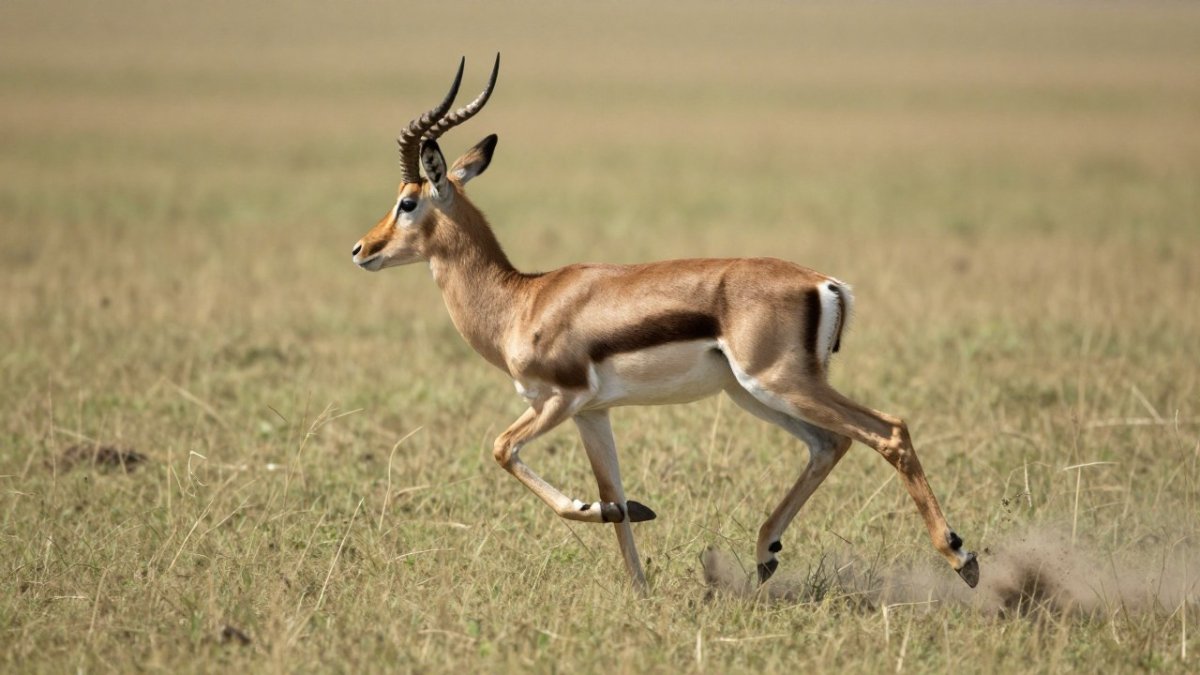
Escape behavior is more than raw speed. Prey often start running at the moment a predator is spotted rather than waiting until the chase is underway. Some species zigzag, while others move in ways that exploit the predator’s own limitations.
The energetic cost is real. Learn how climate change affects primary consumers and their survival strategies to see how environmental shifts change these trade-offs. Sprinting burns energy quickly, so prey animals generally reserve maximum effort for moments of genuine threat.
The article compares how escape tactics differ between prey types and their costs.
| Defense | Main mechanism | Key cost |
|---|---|---|
| Camouflage and concealment | Breaks up outline, reduces cues | Fails on mismatched backgrounds |
| Speed and agility | Rapid acceleration, sustained running | High energy use |
| Escape timing | Flight starts when predator spotted | Wasted effort if false alarm |
| Thanatosis | Going limp, playing dead | Works only on some predators |
Predator and Prey Examples Across Habitats
The defenses of primary consumers vary with the habitat they share with their predators, and the clearest way to see this is to compare named species across ecosystems. On open plains, where cover is scarce, speed and vigilance tend to matter most. In forests and dense vegetation, concealment and quiet movement are often more useful. In water, schooling and body shape take over.
Before comparing habitats, it is worth clearing up a common confusion in this topic. A primary consumer is an animal that eats producers, meaning plants and algae, and sits one step above them in the food chain. Most primary consumers are herbivores: deer, rabbits, grasshoppers, and many grazing and browsing species. A predator, by contrast, is an organism that hunts and kills another animal for food. These are different roles, and most primary consumers are prey rather than predators.
On grasslands and savannas, grazing herbivores rely heavily on group awareness and flight. Herd living spreads the cost of vigilance: more eyes scanning means each animal can spend more time feeding, and the group as a whole detects threats sooner. When a threat is detected, the response is often a fast, sustained run, supported by long legs and efficient musculature.
In forests and dense vegetation, concealment and quiet movement are often more useful than speed. Small rodents in leaf litter depend more on hiding, freezing, and staying still, and their body plan favors quick bursts of acceleration and squeezing into cover rather than sustained running. Forest-dwelling browsers may rely on staying motionless against a matching background and on moving only when cover is nearby.
In marine and aquatic systems, schooling and body shape serve functions similar to herd living and camouflage on land. Schooling fish gain the same vigilance-sharing benefit as herds, and the confusion effect of many similar bodies moving together makes it harder for a predator to single out one target. Body shape and coloration can also break up the outline, much as coat pattern does on land.
For anyone studying these relationships, it is sensible to start with the local predator community rather than with a generic list of defenses. The same prey species may show very different behavior depending on which hunters are present, and a defense that works against one predator may be useless against another.
Thanatosis: Playing Dead as a Prey Adaptation
Thanatosis, the behavior commonly called playing dead, is a defense used by some prey animals when they cannot escape or hide. The animal goes limp, sometimes with its body posture or breathing altered, which can cause a predator to lose interest. Some predators avoid carrion or prefer live prey, so an apparently dead animal may be left alone.
This tactic is most useful as a last resort. It depends on the predator’s feeding preferences, so it does not work against every hunter. Its effectiveness is an area where the research base is thinner, and it should be described as one possible strategy rather than a reliable rule.
Trade-Offs, Energy Costs and Evidence for Evolutionary Change
Every defense carries a cost, and the cost is what makes anti-predator traits a genuine evolutionary problem rather than a free upgrade. Thick armor adds weight that must be carried during flight. Heightened vigilance takes time away from feeding. Fast escape responses burn energy that could otherwise go to growth or reproduction. Primary consumers therefore balance defense against foraging efficiency and reproduction, and the balance point differs by species, habitat, and predator community.
A concrete way to see the trade-off is to compare allocation across species. A grazing herbivore on open grassland invests heavily in sustained running speed and in large eyes positioned for wide-field vigilance, but that same body plan is poor at squeezing through dense cover. A small forest rodent invests in concealment, burrowing, and quick bursts of acceleration rather than sustained speed, but it cannot outrun a pursuit predator in the open.
Trade-offs also show up within a single animal’s daily budget. Time spent scanning for predators is time not spent eating, and in many herbivores vigilance increases as group size decreases and as habitat cover becomes more open. A common pattern is that animals in smaller groups and in more exposed habitats scan more often, which reduces feeding time and can lower intake. Over a season, that can translate into differences in body condition and reproductive output.
It helps to separate inherited adaptations from individual responses. An inherited adaptation is a heritable trait shaped over generations by natural selection, such as the placement of eyes, the length of legs, the pattern of coat coloration, or the tendency to form herds.
The evidence that these traits evolved in response to predation comes from comparative studies of predator and prey functional traits. Researchers examine how traits align with predator pressure across species and habitats, and they look for repeated patterns: similar defenses appearing independently in lineages that face similar predators, and defenses weakening where predator pressure is low.
Watch out: a defense that looks adaptive can be a liability when the predator community changes. A trait tuned to one hunter, such as a coat pattern matched to grassland, can become a conspicuous mismatch when the habitat is converted or when a new predator with different senses arrives.
Applying These Adaptations: A Primary Consumer Adaptations to Predators Worksheet
Use the following worksheet to analyze any primary consumer you are studying:
- Identify the animal’s trophic position and main predators
- List its visual concealment traits (color, pattern, body shape)
- Note its speed, agility, and escape behavior
- Record sensory adaptations such as eyesight and hearing
- Check for group behavior or herd vigilance
- Determine whether thanatosis or other last-resort tactics appear
- Estimate the energy cost of each defense against foraging needs
- Compare the traits with the habitat and predator community
Working through these steps keeps the analysis grounded in the specific predator-prey pressures a species faces rather than in generic assumptions. For readers who want population context on the primary consumers they are studying, our primary consumer population data for ecological research page offers useful background, and our primary consumers definition and examples guide covers the basics in more depth.
Primary consumers and how they handle predators is a topic that rewards careful, species-specific study, and we hope this framework gives you a sound starting point.
Frequently Asked Questions
What are the adaptations of predators?
Predators are equipped with traits that help them locate, catch and subdue prey. Common examples include keen eyesight, acute hearing, sharp teeth and claws, venom, streamlined bodies for speed, and stealth behaviors such as stalking and ambush. Many predators also hunt cooperatively, which can increase their success against well-defended prey. Because predator and prey traits evolve in response to each other, a change in one often drives change in the other over many generations.
Are predators also consumers?
Yes. Predators are consumers because they obtain energy by eating other organisms. They are usually classified as secondary or higher-level consumers when they feed on animals that themselves eat plants. Primary consumers, by contrast, feed directly on producers such as plants and algae. Some animals act as predators in one context and prey in another, so the terms describe feeding roles rather than fixed species categories.
How do primary consumers avoid predators?
Primary consumers rely on several overlapping strategies. Camouflage and concealment reduce the chance of being detected, while alarm calls and herd or flock living allow groups to spot threats sooner. Fast running, rapid changes in direction and warning coloration also help. Many species combine a passive defense, such as staying still in cover, with an active one, such as bolting when a predator gets close. Each strategy carries costs in energy, foraging time or reproduction.
What is thanatosis, and how can it help prey survive?
Thanatosis is a behavior in which an animal feigns death, often by going limp, lying on its side and sometimes releasing a foul odor. Some predators lose interest in prey that appears dead, particularly when they prefer freshly killed food. The behavior is documented in several insects, spiders, opossums and other animals. It works best as a short-term tactic, since a predator may return to check, and it is not reliable against every hunter.
