
Last Updated: November 11, 2026
Quick Summary
A CAPI research project in the Caribbean starts with assessing sample feasibility island by island, since small populations, multiple languages and access constraints can stall fieldwork. Build a realistic timeline with a 10 to 20 interview pilot, choose offline-first software and rugged devices, and confirm the capi research caribbean plan before committing to quotas.
- Assess sample feasibility island by island, not at the regional level.
- Ask for incidence rates, population size, completion time and access constraints in writing.
- Plan a pilot of 10 to 20 interviews before full fieldwork.
- Choose offline-first CAPI software and test sync on a slow connection.
- Monitor timestamps and GPS daily to catch rushed or misplaced interviews.
Table of Contents
- CAPI Versus CAPRI: Clearing Up the Terms
- Assessing Sample Feasibility Before You Commit
- Building a Realistic Market Research Project Timeline
- Choosing CAPI Software and Devices for Field Conditions
- Protecting CAPI Data Quality Best Practices in the Field
- Estimating CAPI Research Cost and Budgeting
- Scheduling Your Next Caribbean CAPI Project With Accurate Market Research
- Frequently Asked Questions
Running computer-assisted personal interviewing (CAPI) research in the Caribbean takes more planning than most teams expect, since capi research caribbean projects span many islands, languages and infrastructure levels. The region spans many islands, languages and infrastructure levels, and a project that looks simple on paper can stall in the field. This guide, from Accurate Market Research, walks through the decisions that determine whether a CAPI study delivers clean data on time.
CAPI Versus CAPRI: Clearing Up the Terms
Teams often search for CAPI and CAPRI as if they were interchangeable. They are not. CAPI, computer-assisted personal interviewing, is the method of using a tablet or laptop to administer a questionnaire face to face. CAPRI is a different acronym altogether, and confusing the two can lead to scoping errors before fieldwork begins.
Clarify the term in your project brief and your vendor agreement. A shared definition prevents a situation where one party budgets for in-home interviews and another quotes an online alternative.
Assessing Sample Feasibility Before You Commit
Sample feasibility is the single decision that most often determines whether a Caribbean CAPI study succeeds or stalls, and it is the first thing to settle in any capi research caribbean project. The region’s small populations, island geography, and multilingual populations mean that a sample plan that looks reasonable on paper can be unachievable in the field. Assess feasibility before you finalize quotas, not after. Sample feasibility explained walks through how to judge whether a target sample is achievable.
What a feasibility assessment should cover
Ask your fieldwork partner for a written assessment that addresses:
- Incidence rates. For a study targeting a specific segment (for example, small business owners, recent migrants, or a particular age band), estimate what share of the general population qualifies. Low incidence means more screening interviews and a longer field period.
- Population size and dispersion. Some islands have small absolute populations in your target segment. Confirm the eligible population is large enough to support your quota before you commit to a per-island sample.
- Expected completion time. A 25-minute questionnaire in one language may run longer in another, and longer interviews reduce daily completes per enumerator.
- Access constraints. Gated communities, rural areas, and neighborhoods with limited street addressing can slow listing and selection. Ask how the field team will handle them.
- Seasonality. Hurricane season, major festivals, and school holidays affect availability and travel. Build these into the field calendar.
Cross-country comparability
A multi-island study raises a question single-country studies do not: are you measuring the same thing in each market? Confirm that the questionnaire, translation, and sampling frame are comparable across islands, and document any deviations. A common pattern is to allow minor wording changes for local idiom while keeping the core question and response scale identical. Record every deviation so analysts can account for it.
Island logistics and fieldwork planning
- Travel and inter-island transport. Ferry and flight schedules constrain how many islands a supervisor can cover in a week. Plan supervisory visits around them.
- Listing and selection. Where street addressing is unreliable, teams may need to list dwellings on foot before selection. Budget time for listing separately from interviewing.
- Field team recruitment. Local enumerators improve access and response rates, but they need training on the instrument and the consent script. Recruit and train before the field period, not during it.
- Connectivity and sync. Plan daily sync points at a base with reliable Wi-Fi, and confirm devices can hold several days of interviews if sync fails.
A feasibility checklist
Before you sign off on quotas, confirm: eligible population size per island, incidence estimate, expected completion time per language, listing method, travel and supervisory plan, and a contingency for weather or transport disruption. If any of those is unknown, the sample plan is not yet feasible.
Watch out: a quota that is achievable on the largest island in your study may be unachievable on a smaller one; assess feasibility island by island rather than at the regional level.
The article lists the checks a feasibility assessment should cover before quotas are finalised.
| Check | What it addresses | Watch-out |
|---|---|---|
| Incidence rates | Share of population that qualifies | Low incidence means longer field periods |
| Population size per island | Whether eligible base supports quota | Assess island by island, not regionally |
| Expected completion time | Interviews per enumerator per day | Longer language versions reduce completes |
| Access constraints | Gated, rural or poorly addressed areas | Budget time for listing |
| Seasonality | Hurricanes, festivals, school holidays | Build into the field calendar |
Building a Realistic Market Research Project Timeline
A CAPI timeline has more stages than a phone or online study. Build in time for questionnaire programming, device preparation, interviewer training, pilot testing, and travel between islands. Weather, public holidays and ferry schedules can all shift fieldwork dates.
Plan a pilot of 10 to 20 interviews before full fieldwork. The pilot exposes wording problems and routing errors while they are still cheap to fix.
Choosing CAPI Software and Devices for Field Conditions
Software and hardware choices are where Caribbean CAPI projects most often go wrong, because the field conditions differ sharply from a single-country study. The right combination depends on your questionnaire complexity, the number of languages, the number of islands, and how much offline time your enumerators will face.
Software selection criteria
Evaluate any CAPI platform against these criteria before you commit:
- Offline-first architecture. Interviews must save locally and sync when connectivity returns. Ask the vendor to demonstrate a full interview and sync cycle with the device in airplane mode, not just to describe it.
- Validation and routing rules. Skip logic, range checks, and required-field enforcement reduce cleaning time later. Confirm the platform supports the question types your questionnaire actually uses, including grids, rosters, and repeated groups.
- Multi-language support. A single instrument with switchable language versions is easier to manage than separate forms per language.
- Audit trail and paradata. Timestamps, GPS capture (where lawful and consented), and interview duration logs support the back-checks and quality monitoring described below.
- Export formats. Confirm the platform exports to the statistical package your analysts use (SPSS, Stata, R, or CSV) without manual reshaping.
- Security and access control. Role-based permissions, device encryption, and remote wipe matter when devices travel between islands.
Other providers offer offline-capable CAPI platforms, and the right choice depends on your team’s technical capacity and your client’s data-security requirements. A side-by-side trial on a pilot instrument is more informative than a feature checklist.
Device selection criteria
- Battery life. Aim for devices that last a full field day with GPS and screen use. Carry power banks; mains power is not guaranteed at every field site.
- Screen visibility. Test in direct sunlight. Bright outdoor conditions are common, and a dim screen slows interviews and increases errors.
- Durability and repairability. A rugged case and a device model with local repair options reduce downtime. Confirm spare devices are available before fieldwork starts.
- Storage. Photo, audio, and GPS capture consume space quickly. Confirm onboard storage and whether the platform supports external storage.
- Connectivity. Confirm the device supports the local mobile bands in each market and that your data plan covers sync volumes. Wi-Fi at the field base is often more reliable than mobile data for bulk sync.
Watch out: a platform that works perfectly in a hotel Wi-Fi pilot can fail in the field if its sync process requires a stable connection for more than a few minutes; test sync on a slow or intermittent connection, not just a fast one.
Language and translation workflow
Surveys in English, Spanish, French, or Dutch-based Creole may each require separate translation and back-translation checks. Build the translation into the programming timeline, not after it, because layout and routing often change when a second language is added. A common pattern is to program the source language first, pilot it, then add translations and re-pilot the translated version with at least a handful of respondents.
A practical selection checklist
Before you buy or license anything, run a one-week trial that covers: a full offline interview, a sync on a weak connection, a language switch mid-interview, an export to your analysis package, and a remote-wipe test. If any of those fails, the platform is not ready for multi-island fieldwork.
Protecting CAPI Data Quality Best Practices in the Field
Data quality depends on consistent interviewing. Train interviewers on the questionnaire, the consent script and how to handle refusals. If you need healthcare professional respondents, see how to recruit healthcare professionals for research.

Monitor timestamps and GPS data, if your software captures them, to spot interviews completed too quickly or from the wrong location. Review incomplete and straight-lined responses daily rather than at the end of fieldwork.
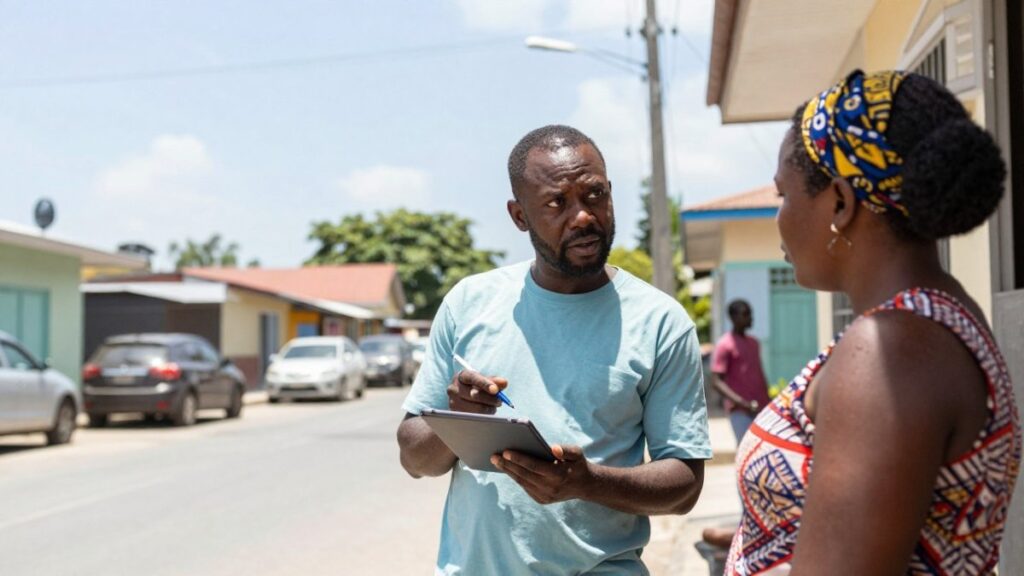
!A field interviewer in a bright outdoor setting in the Caribbean holding a tablet while speaking with a local resident seated under a shaded porch
Estimating CAPI Research Cost and Budgeting
Pricing depends on sample size, number of markets, questionnaire length, travel requirements and delivery format. Request a project-specific quote from Accurate Market Research on its website that itemizes fieldwork, programming, travel, translation and reporting so you can compare options fairly. Before you commit funds, review the common multi-market budgeting mistakes to avoid.
Scheduling Your Next Caribbean CAPI Project With Accurate Market Research
A well-run CAPI study in the Caribbean depends on early feasibility checks, a realistic timeline, sound device and ethics choices, and disciplined quality control. Plan each of those stages before you lock in fieldwork dates.
If you are scoping a Caribbean study now, request a quote from Accurate Market Research to discuss sample feasibility, timelines and budget for your specific project. Accurate Market Research serves clients across the Caribbean and Latin America, and we can help you plan the fieldwork around your research goals.
Frequently Asked Questions
What is CAPI research?
CAPI stands for computer-assisted personal interviewing. An interviewer reads questions from a tablet or laptop and enters responses directly into the device during a face-to-face conversation. Compared with paper questionnaires, the software can enforce skip patterns, apply range checks, and time-stamp each interview, which reduces entry errors. CAPI suits research where respondents may have limited internet access or where a personal interview improves response quality. Teams commonly use it for household, agricultural, and public opinion studies in Caribbean markets, where connectivity and literacy conditions vary by island and community.
When should a research project use CAPI instead of online surveys?
Choose CAPI when your target respondents are hard to reach online, when questions are complex enough to benefit from an interviewer’s clarification, or when the sample must reflect rural or low-connectivity households. Online surveys are usually faster and cheaper for panel-based consumer audiences with reliable internet access. A practical test is to compare coverage: if a meaningful share of your target population cannot be reached online, CAPI is likely the better fit. Pricing depends on quantity, dates, and delivery, so request a quote from Accurate Market Research for current figures.
How long does a Caribbean CAPI research project take?
Timelines depend on sample size, the number of islands or regions covered, questionnaire length, and how quickly devices and interviewers can be deployed. Most projects move through questionnaire programming, pilot testing, interviewer training, fieldwork, and data cleaning in sequence, and fieldwork often takes the longest. Build in extra time for weather, travel between islands, and any translation or language review. A project-specific schedule can be scoped once your brief and sample requirements are known.
What should a brief for a Caribbean CAPI research project include?
A useful brief states your research objectives, target population and geographic areas, required sample size and quotas, questionnaire length, languages, and the decisions the findings will support. Include any consent or data protection requirements, deadlines, and the reporting format you need. Specifying these up front lets a fieldwork partner assess feasibility, recommend a timeline, and quote accurately rather than revising estimates mid-project.
